

Mapping the Mind: Understanding Robert Kegan’s Constructive-Developmental Theory and the Evolution of Adult Thinking
Recognizing that development is not about being better, but being more whole, is the key to navigating that shift with grace.

Robert Kegan’s Constructive-Developmental Theory offers one of the most transformative ways to understand how adults grow, not just in what they know, but in how they make sense of what they know. This theory suggests that adult development is not about intelligence, superiority, or a fixed hierarchy of thinking. Instead, it’s about the evolving ways we interpret ourselves, others, and the world—a shift in the very structure of our consciousness.
In this post, we’ll break down the stages of Kegan’s theory, explore the difference between hierarchical growth and developmental complexity, and look at how global events and personal reflection are accelerating a widespread shift in collective consciousness.
What Is Robert Kegan’s Constructive-Developmental Theory?
Robert Kegan, a developmental psychologist and professor at Harvard, developed his constructive-developmental theory as a framework for understanding the way adults grow over time—not just in knowledge or maturity, but in their mental complexity and meaning-making capacity.
The theory posits that as we develop, we move through qualitatively different stages of meaning-making. Each stage represents a shift in how we relate to ourselves, others, beliefs, and systems. Importantly, these are not “better” or “worse” stages—they are simply different structures of mind, shaped by our life experiences, personal development work, and the contexts we exist in.
The Five Stages of Adult Meaning-Making
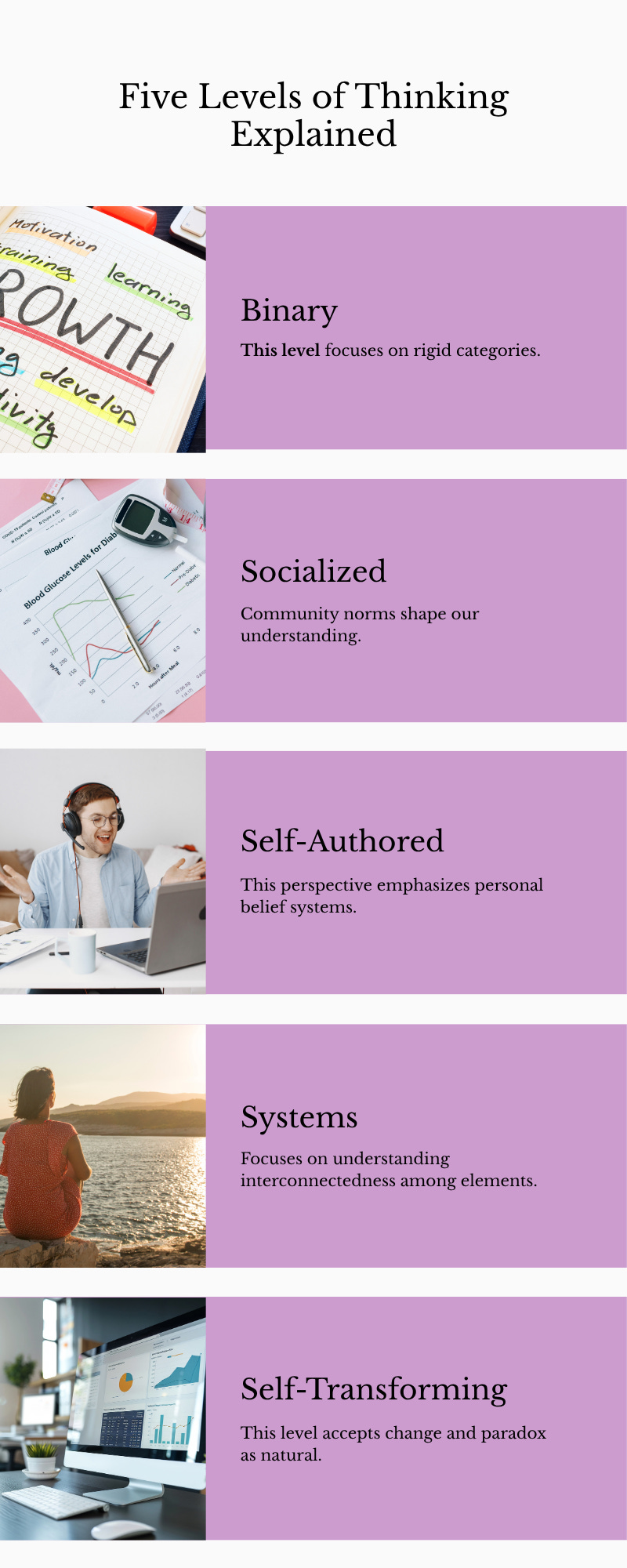
While Kegan’s original theory outlined multiple developmental stages, here’s a distilled map of thinking structures—often referred to in personal growth and coaching circles as a “ladder of thinking.” Let’s explore each, with real-world context and the reminder: these are not rigid steps or a ladder of superiority.
1. Binary Thinking (Stage 2 in Kegan’s model)
How it works: Views the world in black-or-white terms. Right/wrong, good/bad, us/them.
Driven by: Conformity, certainty, and safety.
Common in: Childhood, but also adult environments focused on rules or high stress.
Example: “If you’re not with us, you’re against us.”
This level is very common and is not "less evolved," but simply structured to meet the psychological need for stability and belonging.
2. Socialized or Rule-Based Thinking (Stage 3)
How it works: Identity is formed through external systems: cultural norms, authority figures, religious or institutional rules.
Driven by: Need for belonging, moral alignment with a group.
Example: “This is what my family/community/religion believes, so I do too.”
Here, the self is shaped by the outside world. There’s often loyalty to established norms, and questioning them may feel threatening.
3. Self-Authored Thinking (Stage 4)
How it works: The individual begins to question inherited beliefs and starts forming their own internal value system.
Driven by: Personal integrity, critical thinking, and purpose.
Example: “I respect my community’s beliefs, but I’ve chosen my own based on experience.”
This is where introspection deepens. People at this level often navigate ambiguity and take ownership of their worldview.
4. Systems Thinking
How it works: Recognizes that individuals, cultures, institutions, and problems are interconnected. Looks for root causes, not just surface symptoms.
Driven by: Holistic awareness, empathy, and curiosity.
Example: “That person isn’t bad—they’re a product of systemic conditions we all participate in.”
This thinking is critical for leaders, changemakers, and those working in social impact, education, or complex environments.
5. Self-Transforming or Meta-Awareness Thinking (Stage 5)
How it works: Sees even one’s beliefs as temporary constructs. Open to ongoing evolution. Embraces paradox and ambiguity.
Driven by: Growth, humility, and fluidity.
Example: “This belief works for me now—but I’m open to shifting it as I learn more.”
This mindset is rarely achieved fully or permanently. It's often visited temporarily, during moments of deep insight or personal transformation.
Development ≠ Hierarchy: Why the Levels Aren’t "Better"
A critical point in understanding Kegan’s theory—and echoed powerfully in the video transcript above—is this:
These levels are not hierarchical. They are developmental.
You’re not “better” because you think at a higher stage.
You can exist at different levels depending on the situation. For instance, someone may use self-authored thinking in their career but revert to binary thinking in family disputes.
Growth isn’t about reaching the “top”—it’s about expanding your range and your ability to navigate different perspectives with self-awareness.
How Collective Thinking Is Evolving
The modern world—particularly technology—has become a catalyst for shifting our collective meaning-making structures. Here’s how:
Factor Impact on Thinking Social Media Exposes people to diverse worldviews, forcing empathy and critical thinking Global Crises like COVID-19 Pushes people to question norms, reprioritize values, and reevaluate systems Access to Information Democratises knowledge, challenging rule-based and binary thinking Rise in Therapy & Coaching Encourages introspection, self-authorship, and system analysis
As a result, many people are shifting from binary and socialized thinking to self-authored and systems thinking—an extraordinary transition in human consciousness.
Why This Matters in Your Personal Growth
Understanding where you are in your thinking structure empowers you to:
Reflect with compassion (no shame in where you are)
Expand your flexibility (shift thinking styles as needed)
Navigate complex situations with clarity and empathy
Participate in—and lead—our collective growth
The most powerful takeaway? Knowing that development is contextual and dynamic. You might be self-authored in your work life, yet still operate in binary thinking in romantic relationships. That’s normal. And with awareness, you can grow.
Final Thoughts: A Beautiful Collective Shift
As the video transcript so beautifully articulated, we are living through a profound shift in collective thinking. Our technology, crises, and connection are catalyzing a new era of self-awareness and systems thinking. Recognizing that development is not about being better, but being more whole, is the key to navigating that shift with grace.
Whether you’re deep in your personal growth journey or just beginning, Kegan’s constructive-developmental framework is a roadmap worth exploring. Not to judge, but to orient—and to evolve.
Let’s have better convos.
💜 Cindy
A good read.